Framing the challenge
I led the design of the QuantCo Platform from 0 → 1, working closely with engineering leads, AI researchers, and product leadership to transform a fragmented toolset into a coherent product surface. The design challenge was less interface design, more strategic reframing of how our technology was positioned and delivered.
At the time, the tooling landscape was fractured: internal prototypes stitched together by scripts, powerful tools siloed into specific teams or clients, and every project rebuilding the same scaffolding from scratch instead of assembling it from existing work. The product didn’t exist yet. But the ambition was clear, to create a modular, extensible platform that made the entire AI-native claims processing workflow observable, governable and composable.
Unified claims platform
A platform for managing claims from first notice of loss to payout, built with agentic claims processing in mind.
Claimant experience
Digital, multi-channel intake to collect structured data about claims.
Automated follow-ups
Inbound voice agents
Upfront quality checks
Self-service updates
Claim handler experience
A human-in-the-loop workspace to process claims in collaboration with our agents.
Call assistant
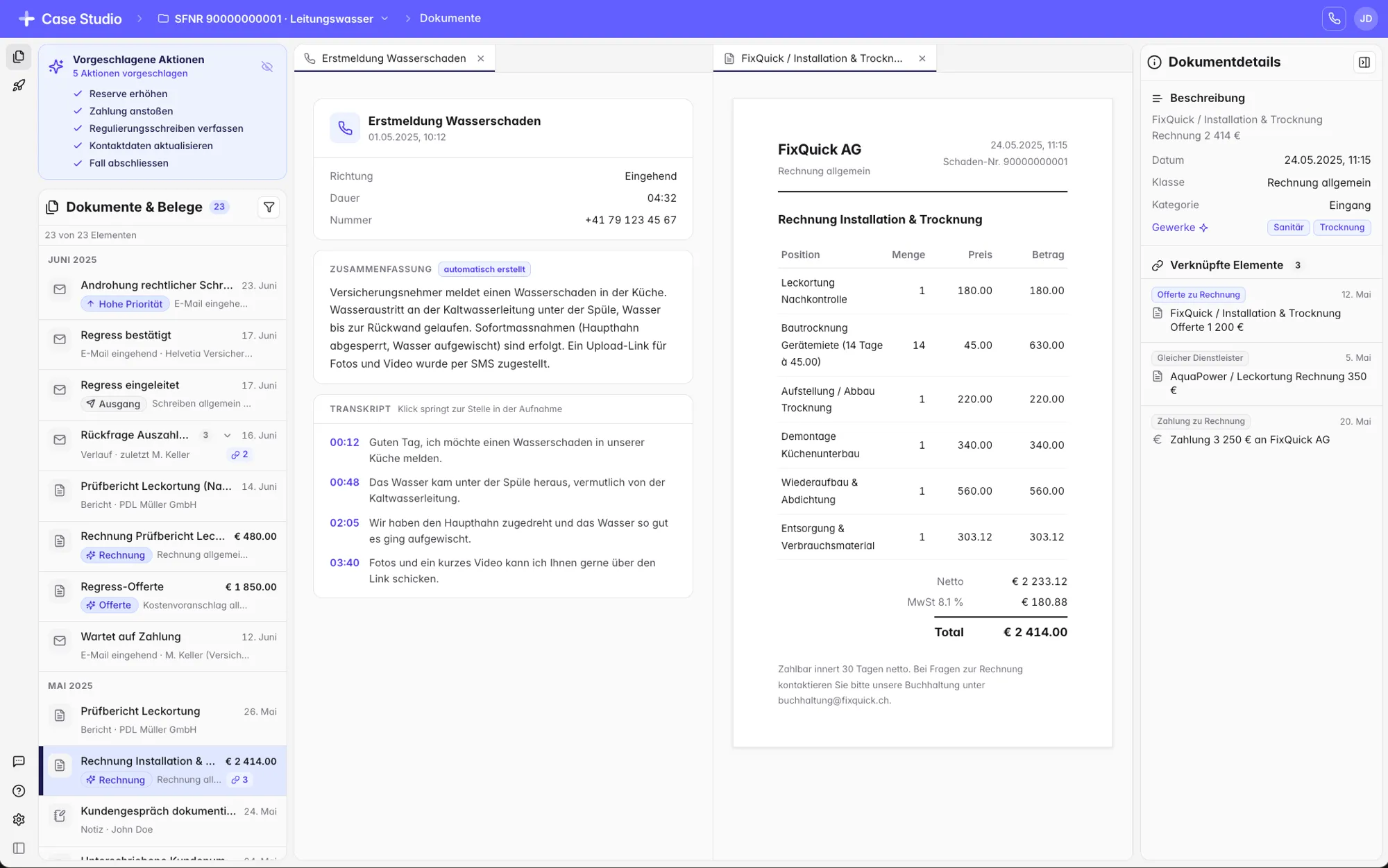
Document workspace
Suggested actions
Observability & audit
Claims agents
Reusable decision units. Each one stands alone, and a claim draws on whichever it needs.
Triage
Coverage
Recourse
Question engine
Invoice checks
Data unification
One centralised place for everything needed to power the agents.
Claim data
Calls, photos, documents, policy
Agent knowledge
Rules, procedures, exceptions
Platform integrations
Connects to existing systems and data sources.
Core claims system
Document stores
Company wikis
Navigating ambiguity, not just complexity
The platform had to bring together the work of many teams, each building tools for a different area of the claims lifecycle, while the agentic technology underneath them was still being developed. What an agent could reliably do shifted month to month, and nobody had a settled answer for how that capability should appear to a claim handler. An agent that reads, drafts or decides needs a defined place for a person to step in, and in insurance that place isn’t a preference: decisions have to be explainable, auditable and attributable to someone. Every agent touchpoint was a product question and a regulatory one at once.
Instead of designing screens for an ever-shifting capability set, I developed a framework for categorising different levels of agentic automation and defined custom interaction patterns for all levels of human-in-the-loop that needed to be supported. Next, I designed the frame our tools would arrive into: a modular structure where each tool could feel native to its own users while sitting inside one navigation system, one design language and familiar interaction patterns. Teams could build into the platform without inventing their own patterns, and a claim handler moving between tools didn’t have to learn a new product each time. It let the platform scale both within existing customers and to new clients adopting our capabilities for the first time.
Stakes
High-stakes, low-complexity claims
Supervised automation
AI capable, but not allowed
AI-led, human-supported
AI suggests action, human approves
High-stakes, high-complexity claims
Supported manual
AI not fully capable
Human-led, AI-supported
AI does what it can, hands off to human
Low-stakes, low-complexity claims
Full automation
AI capable and allowed
AI-run
AI executes
Not a target state
Compliance, legal, and regulatory requirements demand human oversight.
Low-stakes, high-complexity claims
Audited automation
AI imperfect, but allowed
AI-run, human-audited
AI executes, human spot checks
Complexity
From client delivery to a product mindset
The landscape I arrived into at QuantCo was heavily driven by client-specific engineering. Forward-deployed teams of data scientists and ML engineers embedded inside insurers, building what each client needed, then moving on. In practice however, these engagements often became long-running, with no clear handover point. Ultimately, the shift into becoming more product driven came from the need to deliver outcomes at scale in a more sustainable, less labour-intensive format. Early on, I embedded with forward-deployed teams at the client and put product framing into engineering decisions early enough to shape what was built. For every capability we scoped, I asked the same question: which parts of this belong to this client, and which belong to the product?
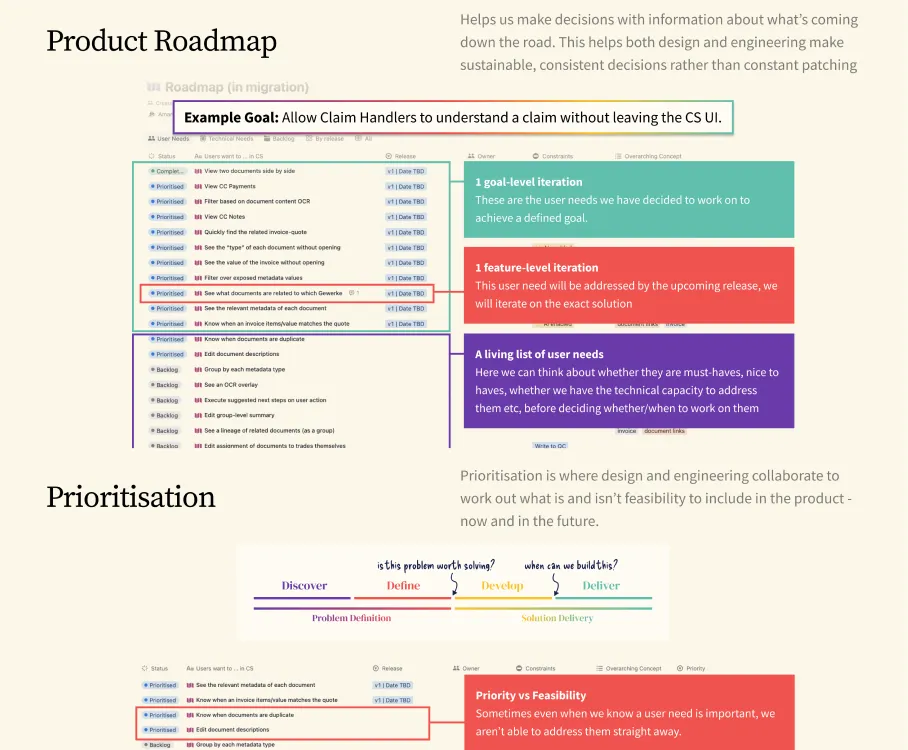
Then came the advocacy piece: these teams had never worked with a designer, nor on a centralised product effort. To break out of the tunnel vision of client delivery I ran vision workshops to define what a QuantCo platform could look like, hosted outreach sessions on product and design thinking, and introduced a roadmap and prioritisation framework to hold client commitments and product bets in the same view. Within 12 months of joining, the role of design had shifted from helping teams deliver better tools, to shaping how these tools came together to create QuantCo’s claims product experience.
Impact and leverage
The platform is now in use at several major insurance companies and has become central to how QuantCo communicates its value to customers, investors, and partners.
By creating clarity across tools, teams, and workflows, the platform helped QuantCo shift from fragmented prototypes to a product mindset and from powerful models to composable, visible outcomes that had a clear path to integration with complex client systems.
-
Joined QuantCo
Joined as first designer to shape the platform experience
-
Design embedded in delivery
Worked directly with customer teams to understand real workflows and constraints
-
Initial framing
Synthesised delivery insights into core journeys and experience architecture
-
A shared vision
Ran workshops across teams to define what a QuantCo platform could be
-
Agentic exploration
Explored agent-based workflows and generative platform capabilities
-
First MVP in production
The first release live with a client, not a prototype
-
Roadmap and prioritisation
A framework holding client commitments and product bets in the same view
-
Patterns for AI features
Extended the design system with patterns for integrating AI features
-
Levels of automation
One human-in-the-loop framework, standardised across every agentic tool
-
The 2026 vision
A working prototype of the platform the whole company could build into